
The Blessing and Curse of Debt Building a Business Without Borrowing in South Sudan
There are some financial lessons we learn from books, some from business school, and others from simply growing up. For me, my relationship with money started with my mother.
Long before I knew words like entrepreneurship, cash flow, capital or financial independence, I was already learning how to make money.
During school holidays and weekends, my mother taught me how to sell sweet potatoes and bananas. The money I made helped me meet some of my own needs. The lesson was simple but powerful:
Learn how to sell to earn. Don’t beg. Don’t borrow.
As a primary school child, I also participated in merry-go-rounds, learning the importance of putting money aside and saving for future needs. Looking back, those experiences shaped the way I think about money to this day.
They taught me independence. They taught me that I could create an income instead of always waiting for someone to give me money. But there was another side to that upbringing.
I developed a strong fear of borrowing. Coming back to Juba and building a business. After university, I returned to Juba in 2016 and continued developing the entrepreneurial side of myself.
I started selling skincare products from Oriflame, a business I continue to operate today through Siapai Authentic Products. Almost ten years later, the business is still standing, and there is one thing that has always surprised me about that journey:
I have never borrowed money to keep the business going, and I have never received external funding. It would be easy to tell myself that this happened because I am an exceptional money manager.
But that would not be the whole truth.
Sometimes, you don’t borrow because you don’t want to, and sometimes, you don’t borrow because you simply cannot access the money. The difficult reality of accessing business finance.
For many years, accessing formal business finance as a small South Sudanese entrepreneur has been incredibly difficult.
Collateral requirements have been one of the biggest barriers. Many small businesses do not own assets that can be used as security, and even when they do, those assets may not meet the requirements of financial institutions.
There has also been a perception among many entrepreneurs that accessing financing can depend on relationships, networks and other factors beyond simply having a viable business.
I recognise that the financial sector is evolving, and there are now efforts and products aimed at supporting small businesses and entrepreneurs.
But for many of us who have been building businesses over the past decade, the reality was that you often had to build with whatever you had. So that is what I did. From online business to a physical shop
When I started selling online, the market was very different. In 2018, customers were still developing trust in online businesses. People wanted to see the products physically. They wanted to know where you were located. They wanted reassurance that the person behind the social media page actually existed.
So I made a decision that required more capital: I opened a physical store. It was not easy, but the shop helped me build trust with customers and gave the business a physical identity. I continued operating the store until 2024.
Then the economic situation became increasingly difficult. Inflation, currency fluctuations, declining purchasing power and insecurity began putting enormous pressure on small businesses.
My shop on Bilpam Road also faced security challenges. At one point, the risk of thieves visiting the shop during the day became a serious concern.
Eventually, I made the difficult decision to close the physical location and return to operating primarily online. I invested in a website, and learned another lesson. I didn’t simply want to return to selling through social media. I wanted to build something more sustainable. So I invested in a website:
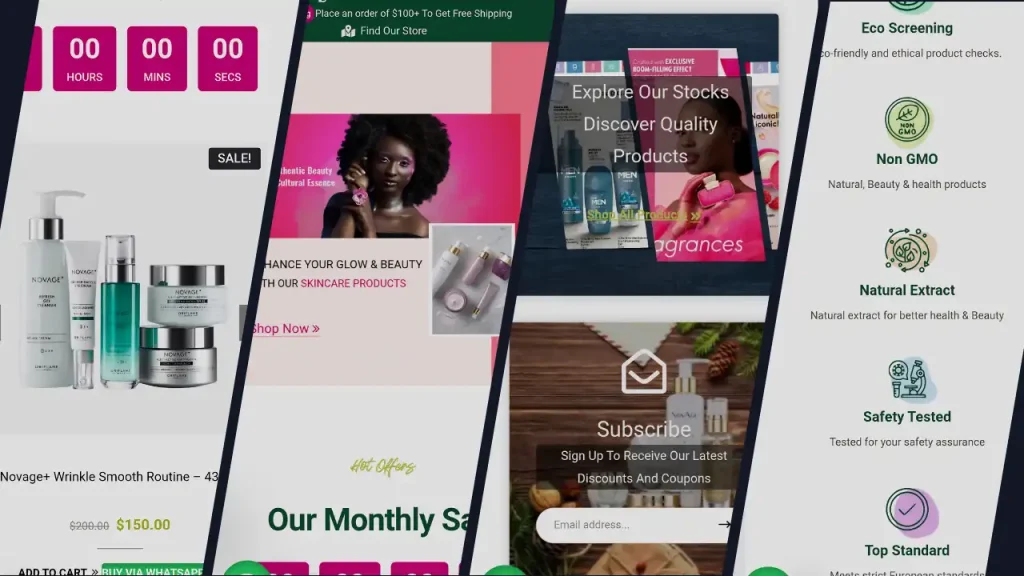
The idea was that customers could discover products, browse them and complete their purchases online. It sounded straightforward. Reality had other plans.
During the first year of having the website, only two South Sudanese customers actually went through the website and completed the purchase process. Just two.
But instead of being disappointed, we celebrated them. They had trusted the platform enough to actually complete an online purchase, and that meant something to us. We even gifted them for trying it.
It was another reminder that entrepreneurship is often about patience.
You invest today and sometimes the results don’t come tomorrow. A new opportunity at Emerald Spa. This year, another opportunity came. Through a partnership with Glory Regency Hotel, Siapai Authentic Products now has products displayed at Emerald Spa reception.
This may seem like a small development, but for me, it represents something much bigger.
After moving from physical retail to online business and then spending time trying to figure out how to make e-commerce work in our market, I now have a physical point where customers can walk in and access our products.

It is not a return to the old model. It is a new version of it, and sometimes, that is what entrepreneurship looks like: not starting over, but starting again with everything you learned the first time.
The loans I couldn’t get over these years
I have considered borrowing money several times. There were moments when additional capital could have helped me buy more stock, expand the business, improve marketing or simply survive difficult periods of inflation and economic uncertainty. I explored the possibility of getting loans. But the answer was often that I didn’t qualify. At the time, I saw this as another obstacle.
I thought about what the business could have achieved if I had access to capital. But recently, I have started looking at it differently.
These are the uncomfortable questions I have been asking myself:
- What if the rejection was actually protection?
- What if not being able to borrow money was actually a blessing?
- What if I had received a substantial business loan during one of those difficult periods?
Perhaps I would have expanded. Perhaps I would have bought more stock. Perhaps I would have opened a bigger shop. Perhaps the business would be much bigger today.
But there is another possibility.
Perhaps the business would have struggled to generate enough income to repay the loan. Perhaps inflation would have eaten into the margins. Perhaps currency fluctuations would have made repayment even more difficult. Perhaps insecurity would have affected the business. Perhaps I would now be carrying a debt that I couldn’t easily repay.
Who knows?
That is the thing about financial decisions: we often judge the outcome we can see while forgetting about the risks we avoided. Debt is not automatically bad. I want to be clear: I am not saying debt is bad. Debt can be an extremely useful financial tool.
A well-structured business loan can help an entrepreneur purchase productive assets, increase inventory, expand operations, hire staff or take advantage of an opportunity that would otherwise be impossible to pursue.
The problem is not necessarily borrowing. The problem is borrowing without understanding the repayment capacity of the business. There is a big difference between:
“I can access this money.”
and
“My business can afford this money.”
Those are not the same thing.
For entrepreneurs, especially those operating in economies affected by inflation, currency volatility and unpredictable consumer spending, that distinction matters enormously.
The blessing and curse of South Sudan
This is why I sometimes describe living and doing business in South Sudan as both a blessing and a curse. The challenges are real.
The market can be unpredictable. Access to capital can be difficult. Infrastructure is limited. Security concerns can affect businesses. Currency fluctuations can quickly change the cost of stock.
But there is also something special about building here.
- There are gaps everywhere.
- There are needs everywhere.
- There are customers looking for solutions.
- There are women and young people creating businesses with very little capital.
- There are entrepreneurs who are learning to survive, adapt and innovate because they have no other option.
And for someone like me, who grew up learning that you can sell something today and use that money to solve tomorrow’s problem, that environment has also taught me resilience.
Almost ten years later…
Siapai Authentic Products is still here. Not because the journey has been easy. Not because I have had access to unlimited capital. Not because I have always made the perfect financial decisions.Almost ten years later…
But because I kept adapting.
From selling online, to opening a physical shop. From closing the shop, to investing in e-commerce. From watching only two customers complete a website purchase, to finding a new physical presence at Emerald Spa.
It has been almost ten years of building, closing, rebuilding, learning and trying again, and perhaps the most interesting part of the story is this: I am still here, and I am not buried in debt.
Maybe one day I will decide that debt is the right tool for one of my businesses.
If I do, I hope it will be because I have carefully considered the cost, the repayment terms, the business opportunity and the risks not simply because someone finally gave me access to money.
For now, I am grateful for what I have learned.
Sometimes we spend so much time praying for the doors that are closed to open that we don’t stop to ask whether those closed doors are actually protecting us. Perhaps the loan I couldn’t get was not always a missed opportunity. Perhaps, in some seasons, it was a blessing in disguise, and that is my Monday Money lesson this week:
Don’t measure financial success only by how much money you can access. Sometimes, financial success is also about knowing what you can afford to walk away from.
Happy New Week.
Juliana Siapai
Freelance Journalist
Great piece over here! In my opinion if you had access to a legitimate loan from any financial institution, i am 100% your business would have expanded and you would have paid it up. Your mindset wouldn’t let you keep that loan too long, you would have paid it before it matured actually. Nevertheless the economic situation is unpredictable but south sudan is an anomaly that can’t be and hasn’t been explained in any written or spoken data! The market is completely unpredictable. Bargaining power is really subjective and changes constantly according to my observation, i have tallied all my monthly sales and i can guarantee you there is no uniformity at all. One month you are exceeding yet another you are just averaging.
If you ever get access to financial loans, be brave enough to to take it thats the only way you will repay it.
Juliana, I have to admit I initially misunderstood the message of this article. but after reading it properly, I realised the message is much deeper.
One thing that really stood out to me is the reality of accessing business finance in South Sudan. Sometimes entrepreneurs don’t bootstrap because they don’t want funding; they bootstrap because the funding simply isn’t accessible to them. The challenges around collateral, qualification and the unpredictability of the economy are very real.
At the same time, your journey made me think about another kind of capital we should be investing in: our skills.
The online business landscape today is very different from what it was several years ago. With digital marketing, content creation, e-commerce, AI, social media and other digital skills, there are now opportunities to build businesses with much less upfront capital than before.
Perhaps there is value in building a blend of both: developing the skills to create income with what you have, while remaining open to strategic financing when the opportunity and repayment capacity make sense.
Capital can accelerate a business, but skills can help you create opportunities even when capital is limited.
Thank you for sharing such an honest journey, Juliana. Wishing you and Siapai Authentic Products continued growth and many more doors opening.